

What is Data Observability for Financial Services
Data observability is a foundational discipline for financial services professionals and data teams, encompassing the continuous monitoring, management, and governance of data pipelines, data quality, reliability, and compliance. For banks, capital markets firms, wealth management organizations, and enterprise data teams, understanding what data observability is and how to implement it effectively has never been more important.
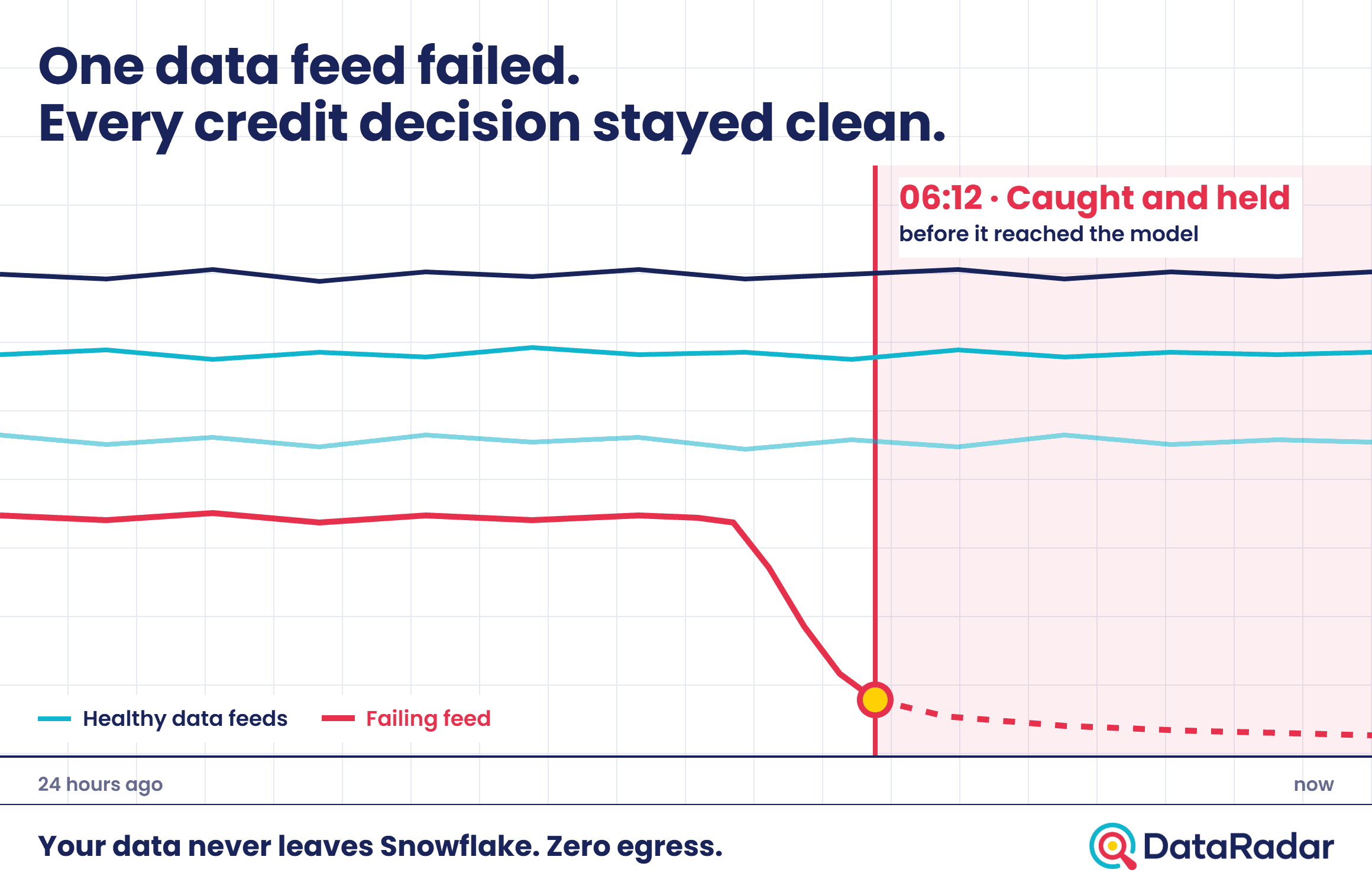
The Financial Services Data Challenge
Banks, capital markets firms, and wealth managers face tough data challenges today. AI needs clean, accurate data. Regulators are pushing harder on three fronts:
-
DORA
Calls for full ICT risk management
-
SOX
Requires auditable controls over financial data
-
Model risk guidance
Demands validation, documentation, and explainability


Yet many data observability tools skip compliance duties or pull sensitive financial data outside the security perimeter.
Most enterprise financial services organizations run two observability tools and still have gaps. Chris Alfaras, CIO, on the architecture shift Snowflake customers can’t ignore.
Regulatory and Compliance Pressures
Facing FSI Data Teams


Where Risk Intelligence Meets Data Quality and Data Observability

Compliance That Doesn’t Slow You Down
DataRadar™ gives financial services teams the visibility regulators look for as a Snowflake-native data observability platform, providing 360-degree insights into data processes and a 360-degree view of the data ecosystem inside your Snowflake account. No data extraction. No third party risk (DataRadar, 2026).
-
Audit trails mapped to SOX Section 404
-
End‑to‑end data lineage from source to financial report
-
Anomaly detection that catches problems before the CFO does
-
ICT risk monitoring and incident logging built for DORA
-
Automated issue resolution can reduce manual work and save time for data operations teams.
-
Model input quality scoring aligned to SR 26‑2
-
Your data never leaves your Snowflake account. Period.

Risk Teams Get Their Data
Stop treating data quality and risk as separate conversations (Federal Reserve System, 2026). Combining them improves operational efficiency because teams are continuously monitoring critical feeds instead of reacting after failures.
-
Real time dashboards built around key metrics and data quality metrics your risk committee will open.
-
Automated monitoring with data quality checks tied to risk workflows, not inboxes.
-
Historical trend analysis examiners can follow.
-
Model performance tied to the data feeding it
-
Audit‑ready reports without the fire drill
Where Financial Institutions Face the Greatest Risk
-
REGULATORY COMPLIANCE
Read the BreakdownThe Compliance Cliff Is Closer Than You Think
DORA is live. The EU AI Act high risk provisions hit in August. SR 26 2 just superseded SR 11 7. FSI data leaders are running out of runway. In practice, data discovery and data profiling help compliance teams understand which data assets are in scope and where control gaps may exist, giving them the visibility needed to manage risk across regulated data systems.
-
DATA QUALITY
See the NumbersThe $12.9M Problem Hiding in Your Data
Poor data quality costs the average enterprise $12.9M a year, and it often first appears as unexpected shifts in data values or distribution. Distribution refers to the expected range of data values in a dataset. In Financial Services, that number lands on the CFO’s desk, which is why teams should monitor data quality dimensions with explicit data quality rules to catch data quality issues earlier.
-
FRAUD AND OPERATIONS
Close the Blind SpotsWhen Your Data Stops Talking, Fraudsters Listen
Silent feed failures are the blind spot real time fraud detection can’t survive. They often begin as data delays or missing data, leaving fraud models to work from incomplete data. Monitoring the entire data pipeline helps surface these data issues before they reach operations teams.
-
MODEL RISK
See Why AI StallsWhy 88% of AI Projects Never Reach Production
The data inputs are usually the reason, which is why analyzing data over time matters more than checking inputs only once. For FSI firms running credit, pricing, and trading models, that’s a regulator scrutiny problem. Model risk also rises when machine learning models face data drift or data quality degradation in production.
-
ARCHITECTURE AND COST
See the ArchitectureWhy Your Data Should Never Leave Home
Every observability tool that extracts your data adds cost, security risk, and a third party breach surface. The architecture matters more than the features. When data infrastructure is hard to observe, organizations exceed cloud budgets by 13% on average. Better observability helps optimize resource utilization in cloud environments, and using resource utilization metrics to track background data processing jobs can reduce cloud spending by 32%. Volume measures the amount of data processed in pipelines.
-
AI GOVERNANCE
Read the ImperativeWhen AI Takes Action, Bad Data Becomes a Crisis
Agentic AI in FSI means autonomous trades, autonomous approvals, and autonomous customer decisions. Bad data inputs are no longer an inconvenience. AI governance depends on high quality data across the data lifecycle, from data collection through data processing. Issues like duplicate records and missing values can quickly turn autonomous decisions into compliance breaches and customer-impact incidents.
Frequently Asked Questions
Does DataRadar™ require my data to leave Snowflake?
No. DataRadar™ is a Native App, which means it runs inside your Snowflake account. Your data never moves, never gets copied to a vendor cloud, and never crosses your security perimeter.
How does DataRadar™ support DORA readiness?
DataRadar™ gives you ICT risk monitoring, anomaly detection, and full audit logging that align with DORA. The native architecture cuts third‑party risk because your data never leaves Snowflake.
How does native architecture help with data residency?
DataRadar™ runs inside Snowflake as a native app. Your data stays put, which makes life easier under GDPR, US state privacy laws, and cross‑border rules.
Does DataRadar™ integrate with our GRC platform?
DataRadar offers APIs and webhook integrations that connect to common Government, Risk, and Compliance (GRC) platforms. Quality issues can trigger risk events, and quality scores can feed your enterprise risk dashboards.
How does DataRadar™ support model risk management?
DataRadar tracks the quality of data feeding your AI, credit, and pricing models, including accuracy, completeness, consistency, and distribution stability. Quality scores plug into model validation workflows, which supports SR 26‑2 readiness.
Trust Your Data. Power Your AI.

$12.9M
avg. annual cost of poor data (DORA,2022) reflecting the impact of poor data quality, data incidents, and preventable data downtime across enterprise environments

70%
will adopt by 2027 (SOX, 2002), as adoption rises with growing data volumes and the need for better visibility into volume, the amount of data processed in pipelines.

Only 40%
of AI prototypes succeed (DORA, 2022), often because teams lack strong data reliability and the ability to monitor data quality before production.