


Agentic AI Governance: The 4 Requirements for Enterprise Deployment
-

Ken Kasee is a 3x Telly Award-winning content marketer and digital marketing strategist with over 25 years of turning complex SaaS technology into clear, engaging stories.
There is a fundamental shift happening in how AI operates inside the enterprise. For years, AI was advisory. It analyzed data, identified patterns, and made calls for humans to act on. A human always sat between the AI’s output and any real-world action.
That is changing. Fast.
Agentic AI, systems that take actions on their own with little human input, is moving from pilot to mainstream. These systems do not just flag which customers might churn. They trigger the retention campaign. They do not just call out suspicious transactions. They freeze the account. They do not just suggest inventory adjustments. They place the order.
The shift is being driven by hard math. Agentic AI cuts decision cycles from days to seconds. It scales without adding headcount. It runs around the clock. For competitive industries, the question is not whether to ship agents but how fast they can ship them safely.
By 2028, 33% of enterprise applications will include agentic AI, up from less than 1% in 20241.
The market is on track to reach $199 billion by 2034, growing at over 40% annually2.
This is not a distant future. It is happening now. And it creates governance risks most teams are not ready for.
Why Agentic AI Changes the Governance Stakes
When AI was purely advisory, data quality issues were a black eye but not a crisis. A bad call could be ignored. A bad guess could be overruled. Humans were the safety net.
With agentic AI, the safety net disappears. When an agent acts autonomously:
- The impact is immediate. There is no human review buffer. Bad data leads to bad action.
- The scale is massive. Agents can take thousands of actions per minute. A single data quality issue can cascade into thousands of mistakes.
- The damage may be irreversible. Some actions, such as sending notes, placing trades, or updating records, cannot be undone.
Picture a customer service AI agent that automatically approves refunds based on customer history. If that history is stale or inaccurate, the agent might pay out fraudulent claims or deny legitimate ones for your best customers. Either way, the harm occurs before any human knows there is a problem.
Or consider a fraud-detection agent that automatically freezes accounts. If transaction data is delayed or an agent misreads a normal travel pattern as fraud, it can lock out a CEO mid-flight during a six-figure deal. The customer call comes hours later. The trust hit comes faster and lingers long after the account is unfrozen.
The 4 Agentic AI Governance Requirements
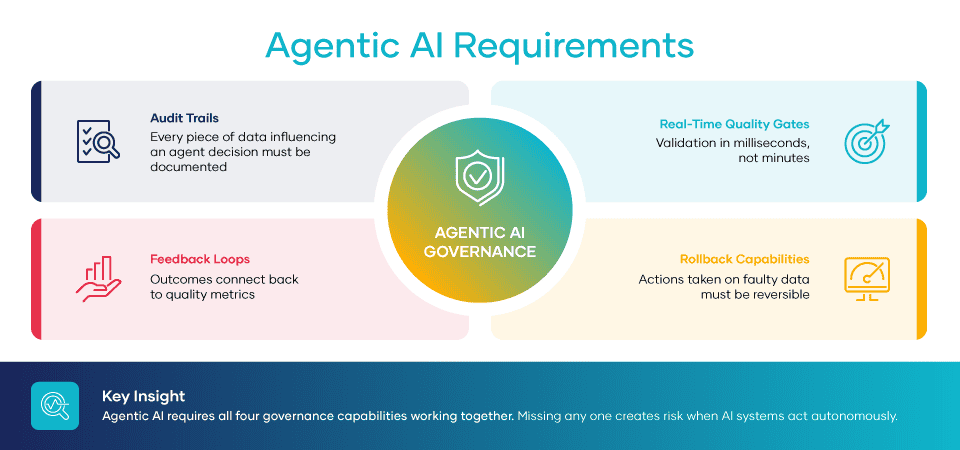
Organizations that ship agentic AI need governance that did not exist in the advisory AI era. Four requirements are non-negotiable.
1. Complete Audit Trails
Every data point that shapes an agent’s decision must be on file. When an agent takes action, you need to trace it back. What data did it see? What was the state of that data at decision time? Which rules or models drove the call?
Decision factor documentation is more than a log of what data the agent saw. It includes the model version, the prompt template, the retrieved context for any RAG-based agent, the threshold values, and any policy rules that fired. When a regulator asks why a specific decision was made on a specific day, you have to reconstruct that decision exactly. Pulling it together from scattered logs is not the same as having it on tap.
This is not just good practice. It is now a regulatory requirement. The EU AI Act mandates full logging for high-risk AI systems. DORA requires financial institutions to demonstrate they can withstand stress, including traceability of every AI decision.
2. Real-Time Quality Gates
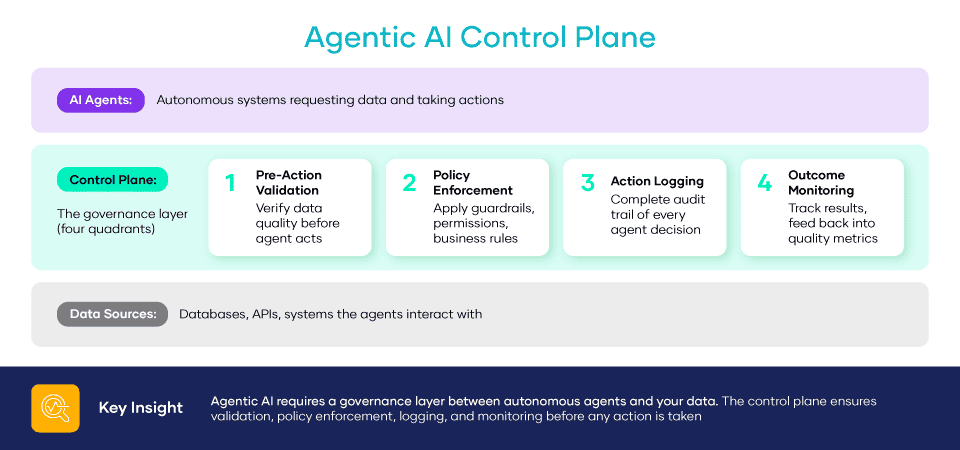
Validation must happen in milliseconds, not minutes. When an agent is about to act, there is no time for batch processing or human review. Quality gates must be embedded directly in the decision flow, blocking actions when data quality falls below acceptable thresholds.
The architecture matters. Inline checks block the action and introduce a small amount of latency. Sidecar checks monitor actions and flag them after the fact, but cannot stop a bad action in flight. For high-stakes decisions, such as financial trades or customer messages, inline is the only safe pattern. For lower-stakes routing, a sidecar may be enough. Most teams need both, with clear rules for which path each action type takes.
This requires a fundamental shift from spot checks to continuous validation. Quality has to be infrastructure, not an afterthought.
3. Feedback Loop Integration
Agent outcomes must connect back to your quality metrics. When actions succeed or fail, that signal needs to flow back into the observability system. Did the retention campaign actually retain customers? Did the fraud flag catch real fraud? Outcomes are the truest quality indicator.
The metrics that matter are concrete. Action precision is the fraction of agent actions that hit the target. Action recall is the fraction of cases that needed action and received one. False positive rate is how often the agent acted when it should not have. Tie those numbers to business outcomes like retention, recovery, or revenue, and you have a real performance picture, not a vibes check.
Without this loop, you are flying blind. You cannot tell which agents perform well from those that confidently make mistakes.
4. Rollback Capabilities
Actions taken on bad data must be reversible. That means designing agent architectures with rollback in mind from day one, not bolting it on after something goes wrong. Transaction logs, state snapshots, and compensation mechanisms are essential components of the infrastructure.
Compensation mechanisms are the reverse path for each action type. For a transaction, it is the offsetting entry. For a customer message, it is the correction note with a clear explanation. For a record update, it is the prior-state restore. None of these are built by accident. They must be designed alongside the action, with clear ownership of who triggers them and the conditions under which they are triggered.
Scroll for more
| Requeriment | What It Means | Why It Is Essential |
|---|---|---|
| Complete Audit Trails | Document every data input and decision factor | Regulatory compliance, debugging, and accountability |
| Real-Time Quality Gates | Millisecond validation before action | Prevent bad data from causing bad actions |
| Feedback Loop Integration | Connect outcomes back to quality metrics | Learn what is working versus what is failing |
| Rollback Capabilities | Reverse actions taken on faulty data | Recover from inevitable mistakes |
Why Data Observability Is the Foundation for Agentic AI
Here is the key point: you cannot meet any of these four requirements without comprehensive data observability.
- Audit trails require lineage. You need to trace data from the source through transformations to the agent input. That is observability.
- Quality gates require monitoring. You need real-time visibility into data quality on every front. That is observability.
- Feedback loops require metrics. You need to connect outcomes to quality indicators. That is observability.
- Rollback requires state tracking. You need to know what data looked like at any point in time. That is observability.
Agentic AI governance is not a separate discipline from data observability. It is an extension of it. Organizations that have built modern observability are set up to deploy agentic AI responsibly. Organizations that have not are in for a steep climb.
Picture the alternative. Six months into a deployment, a customer service team discovers that some refunds processed by their agent were based on outdated customer history. The fix sounds simple. The hard part is identifying which refunds and which customers. Without lineage and state tracking, that work is nearly impossible. The team issues a blanket apology and manually re-reviews all flagged cases, including the legitimate ones. The cost is not just dollars. It is the hit to trust, and often the end of the agent program itself.
How to Prepare for Agentic AI Today
The time to build agentic AI governance is before you deploy agentic AI. Bolting governance on after the fact is much harder than building it in from the start.
Even if you are not running agents today, you will be soon. The organizations preparing now are:
- Building full data lineage across the data assets that matter most
- Setting up real-time quality monitoring infrastructure
- Putting in feedback paths that link business outcomes to data quality
- Designing data systems with auditability and rollback in mind
There is a practical sequence to this. Start with lineage on the data assets that will feed your highest-risk agent use cases. That gives you the audit trail foundation without trying to boil the ocean. Next, add real-time quality gates on the inputs to those same agents. Then build the feedback loop from agent outcomes back to your quality stats. Rollback design comes alongside or just after, baked into how you architect each new agent. Done in this order, you build trust at each stage rather than betting the farm on a big-bang rollout.
These bets pay off even before agentic AI arrives. They improve data quality, reduce issues, and speed up fixes. They also set you up to move with full confidence when the time comes to let AI act.
Key Takeaways: Agentic AI Governance
-
Agentic AI is going mainstream.33% of enterprise applications will include autonomous AI by 2028. This is not optional prep. It is essential.
-
The stakes are fundamentally different. When AI acts autonomously, there is no human safety net. Bad data leads to bad action at scale.
-
Four governance requirements are non-negotiable. Complete audit trails, real-time quality gates, feedback loop integration, and rollback capabilities.
-
Data observability is the foundation. You cannot do agentic AI governance without lineage, monitoring, metrics, and state tracking.
-
Start now. Bolting on governance is much harder than building it in. The bets pay off even before agents arrive.


Sources
¹(2025, June 25). Gartner Predicts Over 40% of Agentic AI Projects Will Be Canceled by the End of 2027. Gartner Newsroom. https://www.gartner.com/en/newsroom/press-releases/2025-06-25-gartner-predicts-over-40-percent-of-agentic-ai-projects-will-be-canceled-by-end-of-2027
²Precedence Research. (2025, September 4). Agentic AI Market Size to Reach USD 199.05 Billion by 2034. Precedence Research. https://www.precedenceresearch.com/agentic-ai-market

