The End of Decoupled Telemetry: Why Enterprise GenAI Demands In-Warehouse Observability
-

Ken Kasee is a 3x Telly Award-winning content marketer and digital marketing strategist with over 25 years of turning complex SaaS technology into clear, engaging stories.
Introduction
Enterprise generative AI rarely fails because the models are weak. It fails because the data feeding those models is untrustworthy, and the tools built to monitor that data were designed for a slower era. The dominant observability model is decoupled and pull-based: it copies your data and metadata to a third-party cloud for inspection. That architecture now carries three costs that AI leaders can no longer absorb. There is a data gravity penalty, an egress bill that grows with every AI workload, and a security arbitrage that turns each external connection into a new attack surface. The fix is architectural, not cosmetic. Move the monitoring engine to the data instead of moving the data to the engine. In-warehouse observability that runs inside Snowflake, with zero data egress and zero metadata extraction, is how data and AI leaders close the trust gap without opening a new risk surface.
The Telemetry Model That Built Observability Is Breaking
The first generation of data observability tools were external SaaS platforms. They connect to your warehouse, pull samples, query logs, lineage signals, and metadata, send them to their own cloud, run the analysis there, and push alerts back to you. That decoupled design made sense when data volumes were smaller and the main job was catching a broken dashboard before a Monday meeting.
Decoupled telemetry means the place where data lives and the place where it is monitored are two separate systems, owned by two different companies, connected by a pipe that runs outside your environment. For a decade, that trade-off looked reasonable. The benefit, visibility, was obvious, and the cost, everything that pipe carries, stayed quietly in the background.
Why generative AI changed the math. GenAI workloads consume far more data, far more often, and with far less tolerance for silent drift than the BI workloads observability was built for. The result is a now-familiar pattern of stalled programs. Gartner projected that at least 30 percent of GenAI projects would be abandoned after proof of concept by the end of 2025, citing poor data quality, escalating costs, and unclear business value as primary causes (Gartner, 2024). MIT research on enterprise deployments found that roughly 95 percent of GenAI pilots produced no measurable profit and loss impact (MIT NANDA Initiative, 2025). McKinsey reported that AI adoption is now near universal while material earnings impact remains rare, a gap that traces back to data and workflow readiness rather than model choice (McKinsey & Company, 2025).
The common thread across all three findings is data trust, not model quality. When the inputs drift, the outputs degrade, and the business stops believing the system. Observability is supposed to catch that drift early. The question for AI leaders in 2026 is whether the architecture doing the watching can keep up with the architecture doing the work.
The Hidden Tax of Pulling Data Out to Watch It
Every time a decoupled tool inspects your data, something leaves your environment. At GenAI scale, that movement is no longer free or invisible. It shows up as two distinct taxes.
The data gravity penalty. Data gravity is the principle that large datasets become economically harder to move as they grow, which is why the sound architectural response is to move compute to the data rather than data to the compute (Pure Storage, 2025). Decoupled observability does the exact opposite. It moves your data and metadata out to a remote engine on a recurring basis. As your AI footprint grows, that backward flow gets heavier and more expensive every quarter, and it fights the same gravity your data platform strategy is trying to respect.
The egress line item nobody forecasts. Cloud providers charge to move data out of their networks, often in the range of roughly five cents to twelve cents per gigabyte, and that asymmetry functions as a transfer tax on any architecture that routinely ships data elsewhere (Aerospike, 2025). For a static dashboard tool, the bill is small. For an observability layer that continuously samples high-volume AI pipelines, the egress meter runs constantly and scales with the very workloads you are trying to monitor. Most teams never put this number in the business case, because the SaaS license looks like the full price. It is not.
The Security Arbitrage of External Telemetry
The most underpriced cost of decoupled telemetry is not financial. It is the risk created by every external connection that touches your most sensitive data.
Every pipe out is a new attack surface. Third-party access has become the fastest-growing breach vector in the enterprise. Verizon found that the share of breaches involving a third party doubled from 15 percent to 30 percent in a single year (Verizon Business, 2025). IBM reported that supply chain and third-party compromises now account for a meaningful share of breaches, with an average cost approaching 4.9 million dollars per incident (IBM, 2025). In 2025, attackers compromised a widely used third-party sales tool and used its connection tokens to pivot into hundreds of downstream Salesforce and Google Workspace environments, a textbook example of how one trusted integration becomes everyone’s blast radius.
An external observability platform is precisely this kind of integration. It provides broad read access to your data and a persistent connection outside your environment. That is a lot of trust to grant a tool whose entire job is to look.
The metadata problem. Defenders of the decoupled model often argue that the tool extracts only metadata, not raw records. That distinction is thinner than it sounds. Schema, lineage, column names, query text, and access patterns reveal where your sensitive data lives, how it flows, what your models train on, and which business logic depends on it. Metadata is a map of the crown jewels. Extracting it is still extraction, and it is still a target.
This is the security arbitrage at the heart of decoupled observability. Teams accept the external pipe because the benefit is immediate and visible, while the risk is deferred and diffuse. The trade looks fine right up until a third-party token becomes the breach. Pricing that risk correctly changes the architecture decision.
Why In-Warehouse Observability Is the Architectural Answer
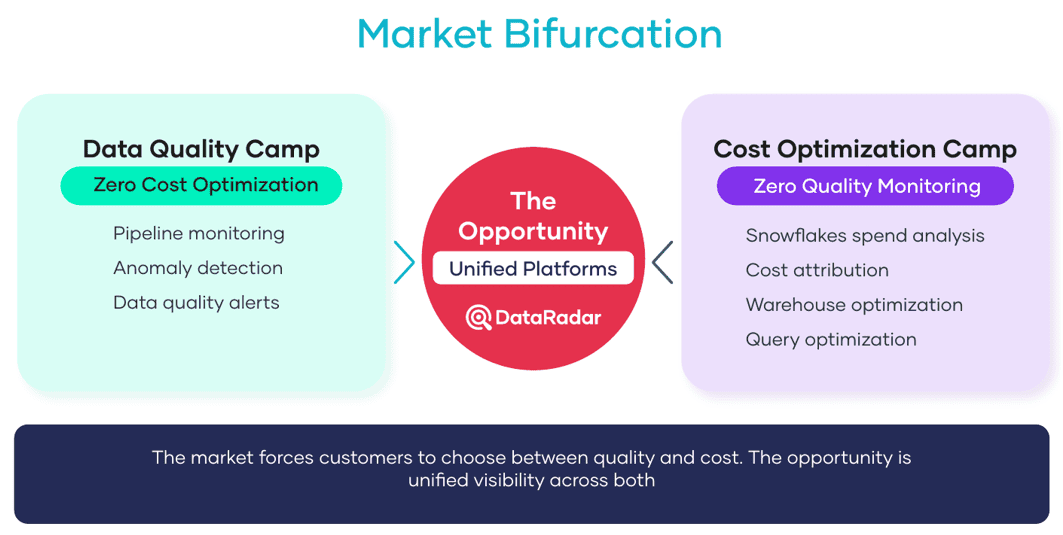
For years, the observability market told AI leaders to pick a side. One camp watches data quality but cannot optimize cost. The other camp cuts Snowflake spend but is blind to the quality problems driving that spend. Buying both means two vendors, two external pipes, two security reviews, and no integration between the signals that actually belong together. The architectural answer is not a better point tool. It is a different place to run the engine.
Architectural Insight: The Two Camps vs the Unified Solution
The Legacy Paradigm (the problem). Modern data operations are fractured into two disconnected silos. On one side sit quality-only platforms. On the other sit standalone cost-only utilities. This creates a fragmented perimeter with multiple external security reviews, isolated operational budgets, and zero cross-engine integration.
The DataRadar Paradigm (the solution). A single, unified container architecture running natively inside your perimeter. By combining data quality tracking and cost optimization into one engine, you inherit your existing Snowflake role-based access controls, deploy from the Marketplace in under 30 minutes, and achieve an absolute zero-egress posture.
The split is easiest to see laid side by side. Each camp owns a real capability and a real blind spot, and the gap down the middle is the integration AI leaders actually need.
Reading across the diagram, the problem is structural rather than incidental. The left camp sees the quality defect; the right camp sees the credit burn; neither connects the two, because the signals live in separate tools owned by separate vendors. Buying both does not bridge the middle. It just doubles the perimeter you have to defend.
Move the engine to the data, not the data to the engine. A Snowflake Native App runs entirely inside your Snowflake account. Monitoring runs where the data already lives, so nothing has to leave to be watched. Zero data egress. Zero metadata extraction. The data gravity penalty disappears because there is no backward flow, and the egress tax goes to zero because nothing crosses the network boundary. This is the in-warehouse model: a single engine that observes data in place rather than a remote engine that pulls data out (Snowflake Inc., 2024).
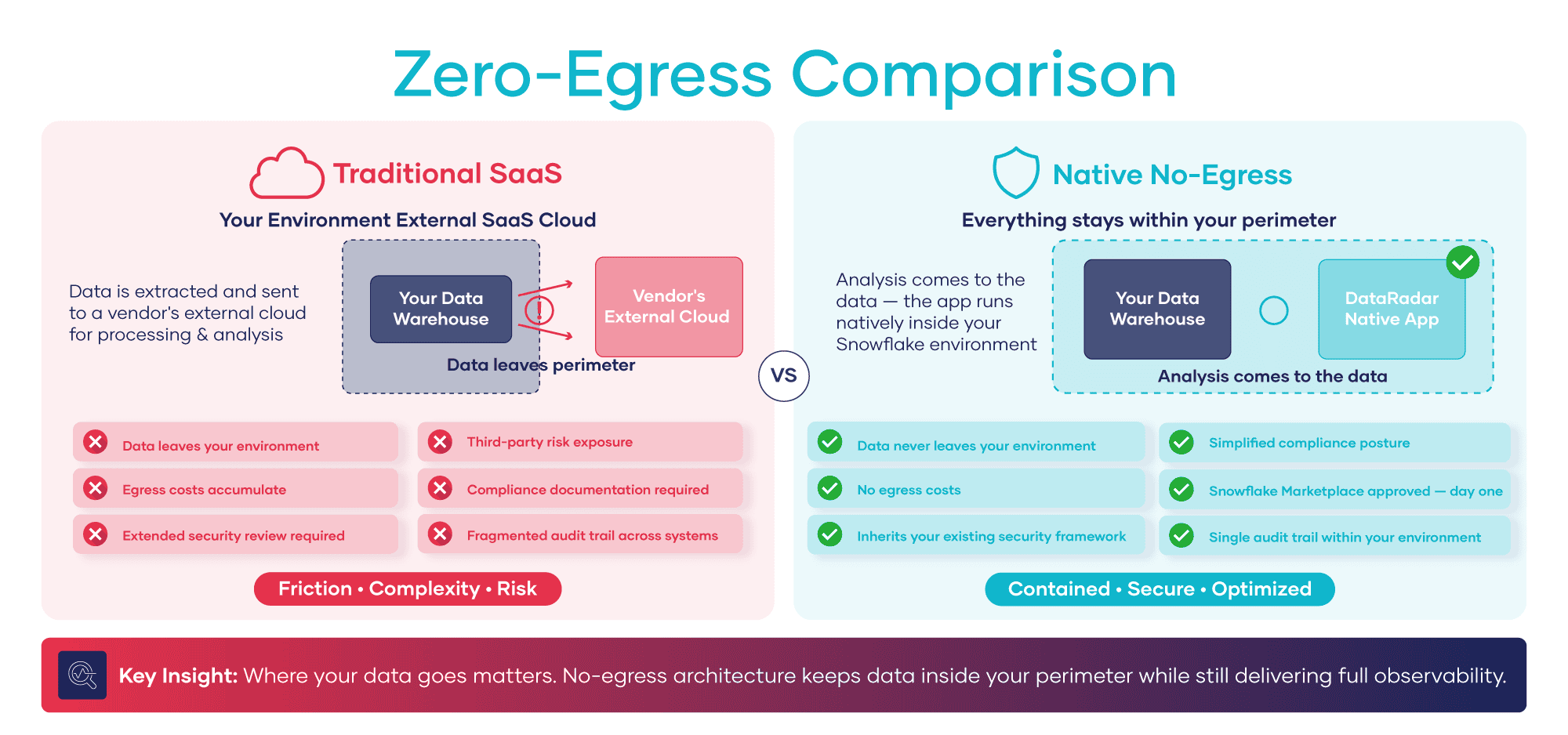
Put the two deployment models side by side, and the difference stops being abstract. The comparison below contrasts the traditional, pull-based SaaS pattern with a native, no-egress one. Everything in the left column- data leaving your environment, accumulating egress costs, an extended security review, third-party risk exposure- is a direct consequence of moving data out to watch it. Everything in the right column follows from the opposite choice: keep the engine inside the perimeter.
The right column is not a feature list; it is what you get for free when the architecture changes. No egress meter, because nothing crosses the boundary. One security framework inherited rather than two reviewed. A single audit trail instead of a fragmented one. The model on the left was the right call for a slower era. The model on the right is the one enterprise GenAI now requires.
One perimeter, one security review. Because a Native App runs inside Snowflake, it inherits Snowflake’s own controls: role-based access, encryption, network policies, and audit logging. Your security team reviews one architecture, not two external SaaS platforms with standing connections out of your environment. The security arbitrage closes because there is no external pipe to arbitrage. This is what UNIFIED, NATIVE, RAPID, and APPROVED mean in practice. One platform covering all five dimensions of observability (Data Reliability, Pipeline Health, Performance Optimization, Usage Intelligence, and Cost Visibility), running natively, deployable in under 30 minutes from the Snowflake Marketplace, and paid for with credits finance has already approved.
What Data and AI Leaders Should Evaluate Now
The decision is no longer a feature checklist. It is an architecture question. Before signing another observability contract, ask six things:
- Where does the monitoring actually run, inside your warehouse or inside someone else’s cloud?
- What leaves your perimeter when the tool inspects data: raw records, metadata, query logs, or nothing at all?
- How many separate security reviews and vendor relationships does full coverage require?
- Does the platform cover all five observability dimensions, or only the one or two its camp was built for?
- Does it connect data quality issues directly to cost impact, or keep quality and spend on separate ledgers?
- How fast does it deploy, and is it paid for through existing commitments or a new budget cycle?
If the honest answer to the first two questions is that data leaves your environment on a recurring basis, you are paying the egress tax and carrying the security arbitrage whether or not they appear on the invoice.
Upcoming Live Virtual Presentation: Reserve Your Seat
Data teams are not flying blind because they lack tools. They are flying blind because their tools only cover part of the picture. Join us for a live, deep-dive session mapping the five dimensions of complete data visibility and what it actually takes to close every operational gap.
Title: The Five Dimensions of Data Observability
Date: Thursday, August 13, 2026
Time: 11:00 a.m. PT / 2:00 p.m. ET
Duration: 30 minutes plus a live 15-minute Q&A
Format: Live virtual presentation plus Q&A
Host: Ken Kasee, Brand Director, DataRadar
Featured Speaker: Ram Sola, Product Architect, DataRadar
The Bottom Line for Data and AI Leaders
Decoupled telemetry was the right design for its era and the wrong design for enterprise generative AI. Pulling data and metadata to a remote cloud for monitoring was tolerable when volumes were small, and the stakes were low. At AI scale, it imposes a data gravity penalty, a recurring egress tax, and a security arbitrage that grows with every workload you add. In-warehouse observability removes all three by running inside Snowflake, where your data already lives, with zero egress and zero metadata extraction. It also ends the two-camp tax by putting data quality and cost optimization on one platform, with one security review and one relationship to manage. That is what it means to make your Snowflake data AI-ready.
DataRadar: Trust Your Data. Control Your Costs. Power Your AI.
Frequently Asked Questions
What is decoupled telemetry, and why should an AI leader care?
Decoupled telemetry is an observability design in which your data is monitored by an external SaaS platform that copies samples, logs, and metadata from your environment for analysis elsewhere. It matters because at GenAI scale, that constant outbound flow creates a data gravity penalty, a growing egress bill, and a third-party attack surface, all of which work against the trust and cost goals your AI program depends on. For the full architectural breakdown, The 2026 Enterprise Playbook for Data Observability.
Does in-warehouse observability mean less coverage than a dedicated SaaS tool?
No. In-warehouse observability runs natively in Snowflake and can cover all five dimensions of data observability on a single platform: Data Reliability, Pipeline Health, Performance Optimization, Usage Intelligence, and Cost Visibility. The trade-off most teams fear, depth versus deployment model, is a false choice when the engine runs where the data lives. To see the dimension-by-dimension coverage, download the 2026 Insight Brief: Data Quality and Cost Optimization. [UTL]
How much does decoupled observability really cost beyond the license?
The license is only part of the price. Every recurring data pull moves data out of your cloud, which incurs egress fees that scale with your AI workloads, plus the operational and audit overhead of managing an external integration with broad read access. Those costs rarely appear in the original business case. For a framework to calculate the true total cost, download The 2026 Enterprise Playbook for Data Observability.
Our SaaS observability vendor already passed a security review. Why revisit it?
Because the risk profile changed. Third-party involvement in breaches doubled year over year to 30 percent, and a single trusted integration can become the entry point to hundreds of downstream environments. Any tool with a standing outbound connection and broad read access to your data warrants a fresh look as your data sensitivity grows. For the in-warehouse alternative and its single-review posture, download The 2026 Enterprise Playbook for Data Observability.
How does in-warehouse observability connect data quality to cost?
When quality monitoring and cost optimization run on the same platform inside the warehouse, the system can link a specific quality issue, such as a failed pipeline, duplicate data, or a reprocessing loop, directly to the Snowflake credits it burns. Camps that sell quality and cost separately cannot make that connection because the signals live in two disconnected tools. To see how to unify the two ledgers, download The 2026 Enterprise Playbook for Data Observability.
What is the fastest way to evaluate this without a long proof of concept?
A Snowflake Native App deploys in under 30 minutes from the Snowflake Marketplace, runs inside your account with no data leaving your environment, and is paid for with existing Snowflake credits, so there is no procurement delay or new budget cycle to clear before you can see results. For a step-by-step evaluation checklist, download the 2026 Insight Brief: Data Quality and Cost Optimization. [UTL]
References
1.Aerospike. (2025). Cloud egress costs explained for high-performance data architectures. https://aerospike.com/blog/cloud-egress-costs-explained/
2.Gartner, Inc. (2024). Gartner predicts 30% of generative AI projects will be abandoned after proof of concept by end of 2025 [Press release]. https://www.gartner.com/en/newsroom/press-releases/2024-07-29-gartner-predicts-30-percent-of-generative-ai-projects-will-be-abandoned-after-proof-of-concept-by-end-of-2025
3.IBM. (2025). Cost of a data breach report 2025. https://www.ibm.com/reports/data-breach
4.McKinsey and Company. (2025). The state of AI: How organizations are rewiring to capture value. https://www.mckinsey.com/capabilities/quantumblack/our-insights/the-state-of-ai
5.MIT NANDA Initiative. (2025). The GenAI divide: State of AI in business 2025. Massachusetts Institute of Technology.
6.Pure Storage. (2025). The economics of data gravity. https://blog.purestorage.com/purely-technical/the-economics-of-data-gravity/
7.Snowflake Inc. (2024). Snowflake Native App Framework [Documentation]. https://docs.snowflake.com/en/developer-guide/native-apps/native-apps-about
8.Verizon Business. (2025). 2025 data breach investigations report. https://www.verizon.com/business/resources/reports/dbir/