Nine Trends Reshaping Data Operations in 2026: What Enterprises Need to Know
-

Ken Kasee is a 3x Telly Award-winning content marketer and digital marketing strategist with over 25 years of turning complex SaaS technology into clear, engaging stories.

Every few years, the data world experiences a genuine inflection point. The move to the cloud. The rise of the modern data stack. The emergence of real-time streaming.
2026 is another one of those years.
Good data quality now serves as a vital foundation for operational efficiency and decision-making, especially as data volumes continue to increase. As organizations manage larger and more complex datasets, maintaining high-quality data defined by accuracy, completeness, and timeliness has become crucial for dependable reporting and sound analysis.
But unlike previous shifts, which could be addressed with a single technology decision or platform migration, this transformation is multidimensional. Nine distinct forces are converging simultaneously, each amplifying the others and collectively reshaping how organizations create, manage, and extract value from data. Data governance frameworks are essential for managing this complexity and ensuring accountability, providing standard procedures and oversight for data handling across the organization.
The data observability market presents a compelling narrative: expected to reach $3.15 billion by 2025 and expand to $5.45 billion by 2030¹. Furthermore, leading analyses predict that by 2027, 70% of enterprises implementing distributed data architectures will have adopted data observability tools, up from approximately 50% in 2025.² As these trends converge, high-quality data is necessary for AI and analytics, and organizations lose millions of dollars annually due to data quality issues that impact overall performance.
AI projects in 2026 are increasingly focused on building functional, agentic systems utilizing Large Language Models (LLMs) and retrieval-augmented generation (RAG), which depend on high-quality, well-governed data to deliver accurate and trustworthy results.
Understanding these nine trends isn’t optional. It’s the difference between leading the transformation and being swept up in it. Data quality challenges have evolved alongside technological advances, making data quality management more complex and critical than ever.
What Are the Nine Data Observability Trends Reshaping Enterprise Operations in 2026?
Before diving into each trend (which we’ll do in subsequent posts), let’s map the landscape. These trends aren’t separate forces—they’re interconnected parts of a fundamental transformation.
Scroll for more
| Trend | The Shift |
|---|---|
| AI-Powered Predictive Observability | From reactive alerts to predictive prevention |
| Cost-Aware Data Tiering & FinOps | From separate quality and cost tools to unified platforms |
| Unified Data and AI Observability | From pipeline monitoring to complete AI stack visibility |
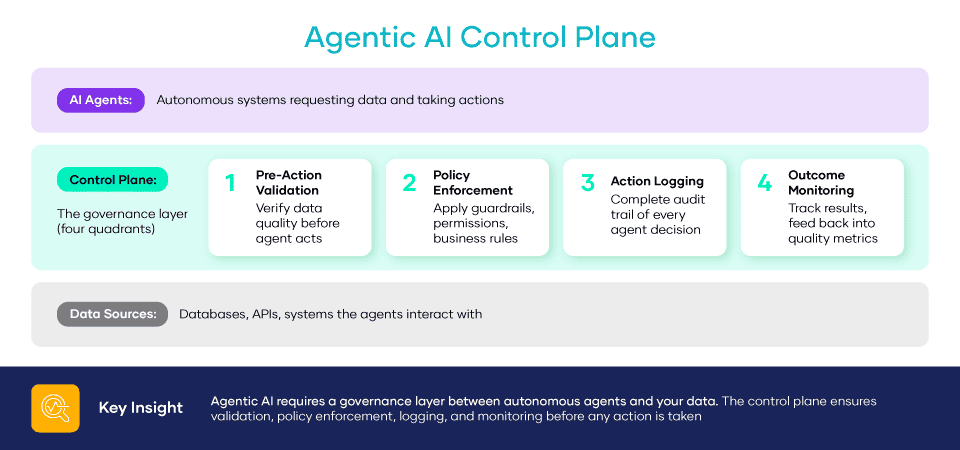
| Agentic AI Governance | From recommendations to autonomous actions requiring new controls |
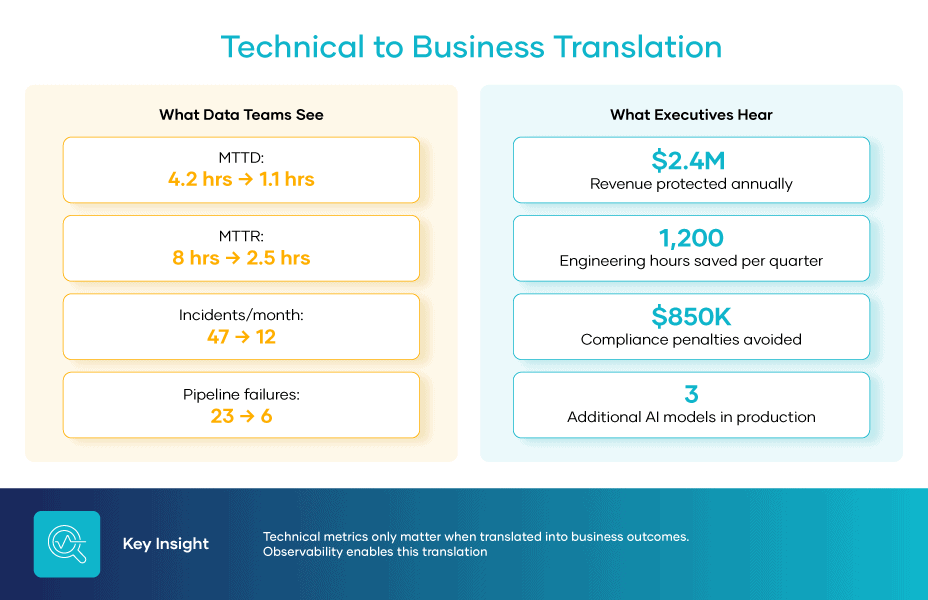
| Observability as Business Value | From cost center to strategic enabler |
| Data Productization | From data assets to self-service data products |
| Real-Time Quality Monitoring | From batch validation to shift-left, streaming checks |
| Cloud-Native Architecture | From SaaS extraction to zero-egress native platforms |
| Regulatory Compliance Automation | From periodic audits to continuous compliance |
Why Do These Data Observability Trends Matter Together?
The critical insight is that these trends don’t exist in isolation. They reinforce and amplify one another, creating both challenges and opportunities.
AI drives everything. Trends 1, 3, and 4 are direct responses to the rise of AI. Predictive observability uses AI to monitor data, while unified observability addresses AI’s complex data needs. Agentic AI governance manages AI’s autonomous actions. However, AI also makes trends 5-9 more urgent. You cannot run AI initiatives without trusted data, self-service access, real-time quality, secure architecture, and regulatory compliance. High data quality builds trust in analytics tools and encourages business users to rely on data-driven insights for decision-making. Maintaining good data quality leads to better decision-making, improved customer experiences, and increased accuracy in analytics and operational efficiency.
Cost and quality are inseparable. Trend 2 (FinOps integration) directly links to Trend 8 (cloud-native architecture). Poor data quality increases cloud costs due to reprocessing. Cost optimization without understanding data quality can lead to new issues. A zero-egress architecture addresses both concerns at once. Maintaining data quality is vital for reliable analysis and decision-making, and ongoing monitoring is key to preserving data quality in real-time data environments.
Governance spans the stack. Trends 4 (agentic AI governance), 6 (data productization), and 9 (compliance automation) all require comprehensive data lineage, audit trails, and policy enforcement. You can’t govern what you can’t observe. Data quality management is a vital part of an organization’s overall data governance strategy and is crucial for maintaining high data quality throughout the organization. Data quality management tools assist organizations in matching records, removing duplicates, validating new data, establishing remediation policies, and identifying personal data within datasets. Building a data quality culture needs buy-in from business users and the entire organization, not just IT or analytics teams.
The Market Bifurcation Problem
Here’s what makes navigating these trends especially challenging: the market has divided in ways that don’t align with enterprise needs.
Data quality tools offer strong observability but lack cost-optimization features. Data quality solutions have been created to address the negative effects of poor data quality and help organizations diagnose and fix data issues quickly and efficiently. You need a separate tool for FinOps.
Cost optimization tools offer smart cost management but lack data quality monitoring. They cannot detect data quality issues that increase costs. Data quality problems can cause operational disruptions, inaccurate analytics, and misguided business decisions. Poor-quality data can result in financial losses and reputational harm, with organizations losing millions of dollars annually due to data quality issues, which impact productivity and decision-making.
This division forces organizations into fragmented tools—multiple vendors, multiple integrations, multiple security reviews—for problems that are fundamentally connected. The trends of 2026 require unified approaches, but the market mainly offers point solutions. Solving data quality issues needs integrated solutions that go beyond isolated tools.
What’s Coming in This Series
The organizations pulling ahead in 2026 aren’t waiting to see how these trends play out. They’re acting on them now.
Over the next several weeks, we’re going deep on each one — what’s actually changing, how the trends connect, what leaders are doing differently, and the questions you need to be asking your team today.
The window to get ahead of these shifts is open. It won’t stay that way.
Next week: Trend 1 — the shift from reactive alerting to AI-powered predictive observability. Prevention is finally possible. Here’s how the best teams are already using it.
Questions for Your Organization
Before diving into the individual trends, assess where you stand. It’s critical to evaluate your organization’s approach to data entry, validation rules, and business rules, as these are essential for maintaining data quality.
- Which of these nine trends represents your most enormous gap compared to your AI and data ambitions?
- How many separate vendors do you currently use for data quality, cost optimization, and governance? Is that fragmentation helping or hurting?
- Are you treating these as separate initiatives or as interconnected parts of a unified data strategy?
- Do you have standardized data entry processes and validation rules in place to ensure data conforms to business rules and quality standards? Implementing validation rules during data entry and integration ensures data conforms to predefined formats, standards, and business rules.
- What percentage of your analytics workload runs on cloud platforms like Snowflake? Is your observability architecture aligned?
- Which upcoming regulations (DORA, EU AI Act, CCPA updates) apply to your organization, and are you prepared?
Key Takeaways
- 2026 is an inflection point. Nine trends are converging simultaneously, reshaping how organizations manage data. This isn’t incremental change.
- The trends are interconnected. AI, cost, architecture, and governance trends reinforce each other. Success requires holistic thinking, not point solutions.
- The market has bifurcated. Quality and cost tools don’t overlap, leading to fragmentation. Organizations need unified approaches.
- 70% adoption by 2027. Data observability is moving from a nice-to-have to a table-stakes requirement. The question isn’t whether to invest, but how.
- Assessment precedes action. Understanding which trends represent your most significant gaps is the first step toward addressing them.
- Data quality assessment is foundational. Assessing data quality involves examining multiple aspects—such as accuracy, completeness, and reliability—using frameworks like the Data Quality Assessment Framework (DQAF) to categorize and measure these metrics. Data quality is often evaluated through various methods and frameworks to help organizations identify and correct data errors.
- Data profiling is essential. Data profiling should be performed to examine datasets for anomalies, statistics, and potential quality issues before analysis.
- Track and report quality metrics. Regularly monitoring data quality metrics and producing progress reports is crucial to gain support for data quality initiatives.
- Monitor AI project performance. Include a monitoring dashboard for latency, token costs, and failure rates in AI project designs to ensure ongoing reliability and efficiency.

Sources:
¹ Mordor Intelligence. (2025). Data observability market size, share, and growth analysis & growth report, 2030. https://www.mordorintelligence.com/industry-reports/data-observability-market
² Gartner, Inc. (2025, September). 6 best practices to implement data observability tools. https://www.gartner.com/en/documents/6974966