The Third-Party Telemetry Loophole: Navigating FINRA 21-29 and SEC Reg S-P in Agentic AI
-

Ken Kasee is a 3x Telly Award-winning content marketer and digital marketing strategist with over 25 years of turning complex SaaS technology into clear, engaging stories.
Bottom Line Up Front
Most observability tools watch your data by pulling it out. Samples, query logs, lineage, and metadata leave your warehouse for a vendor cloud on a continuous basis. For a financial services firm, that outbound flow is not a technical detail. It is an outsourcing arrangement and a service-provider relationship that FINRA Regulatory Notice 21-29 and the 2024 amendments to SEC Regulation S-P expect you to govern, supervise, and document. Agentic AI widens the gap because autonomous systems consume more data, more often, through more tools. The fix is architectural. Run observability inside your Snowflake account as a Native App, so customer information never leaves your security perimeter, there is no new vendor to oversee for that function, and data quality monitoring and cost optimization arrive in one approved app rather than two. This article maps the loophole to the obligations it triggers and shows how a zero-egress, in-warehouse model closes it.
The Telemetry Most Compliance Teams Never Inventory
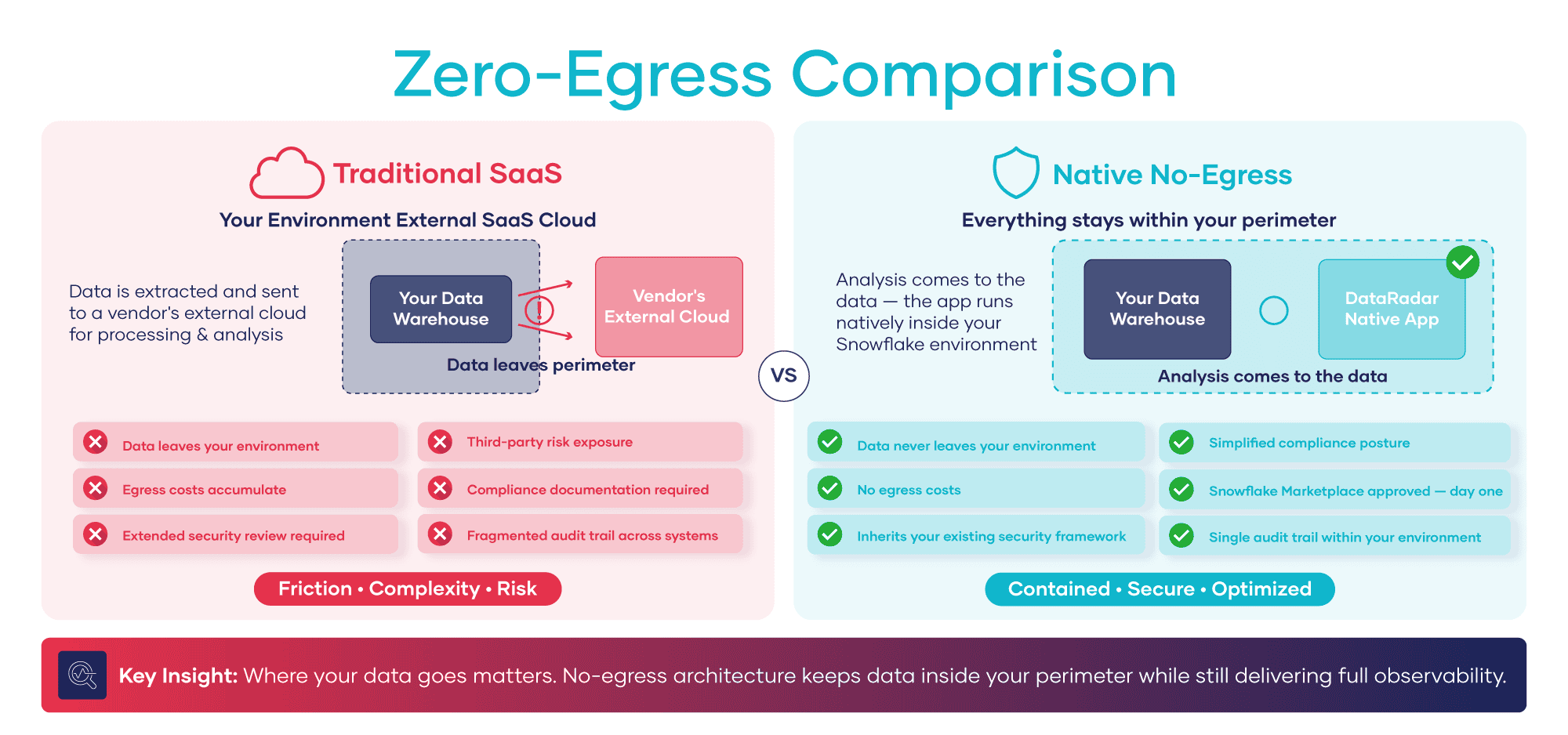
Decoupled, pull-based observability is the industry default. An external platform connects to your warehouse and extracts metadata, query logs, samples, and lineage to its own cloud on a schedule, indefinitely. This model is so common that it rarely gets questioned. It should.
Compliance teams keep careful inventories of the obvious data flows, the custodian feed, the CRM, and the reporting extracts. The observability tool’s outbound telemetry is usually not on that map because no one has filed it as a data flow. Yet query logs can carry identifiers in predicate values, lineage describes the structure of customer data, and samples can have nonpublic personal information. The watcher has quietly become an exporter, and the firm is paying egress charges on every cycle to send its own regulated data to a third party (DataRadar, 2026).
Why FINRA 21-29 Treats Your Observability Vendor as a Supervised Function
FINRA Regulatory Notice 21-29, issued in August 2021, reminds member firms that outsourcing an activity to a third-party vendor does not relieve them of their supervisory obligations. The obligation under FINRA Rule 3110 extends to any function that, if performed in-house, would require a supervisory system and written supervisory procedures (FINRA, 2021). The notice groups the expectations into four areas to hold against any observability tool you connect to.
- Supervision: keep a reasonably designed system and written procedures to oversee the vendor for the life of the agreement.
- Registration: assess whether outsourced personnel performing covered activities need to be registered.
- Cybersecurity: evaluate the vendor’s access to confidential customer information, encryption, and incident history.
- Business continuity: account for the vendor in your continuity planning and testing.
FINRA has disciplined firms when vendors exposed customers’ nonpublic personal information or left cloud servers misconfigured. An external observability platform holds a standing credential to your warehouse and pulls customer-derived telemetry to its cloud. That is a vendor with access to confidential customer data. Under 21-29, you must perform due diligence before onboarding it, control the contract terms and default settings, including data access and retention, and supervise it continuously. Every external observability tool in the stack adds another such relationship to govern and adds it to a function most firms never realized they had outsourced.
Why SEC Reg S-P Now Counts Telemetry as Customer Information Exposure
On May 16, 2024, the SEC adopted the first major amendments to Regulation S-P since the rule’s original adoption in 2000 (U.S. Securities and Exchange Commission, 2024). Reg S-P implements the safeguarding mandate of the Gramm-Leach-Bliley Act (Gramm-Leach-Bliley Act, 1999), and the amendments sharpen it for the modern technology stack. Covered institutions, which include brokers, dealers, investment companies, registered investment advisers, funding portals, and transfer agents, now must do four things that bear directly on telemetry.
- Keep a written incident response program designed to detect, respond to, and recover from unauthorized access to or use of customer information.
- Oversee service providers through written policies that require due diligence and ongoing monitoring, and that ensure providers protect the information and let you know of incidents.
- Notify each affected individual within 30 days when sensitive customer information has been, or is reasonably likely to have been, accessed without authorization.
- Apply an expanded definition of customer information and keep the supporting records.
Under the amended rule, a service provider is any party that receives customer information. An external observability vendor that ingests customer-derived telemetry is squarely a service provider. You must oversee it, confirm it safeguards the information and reports incidents to you, and fold it into your breach-notification analysis. The more places your customer information lands, the larger your Reg S-P surface becomes, and the more vendors you must be ready to account for during an examination. FINRA has expressly linked the two regimes, pointing firms to the Reg S-P service-provider expectations alongside the 21-29 vendor obligations (FINRA, 2021).
Agentic AI Multiplies the Loophole
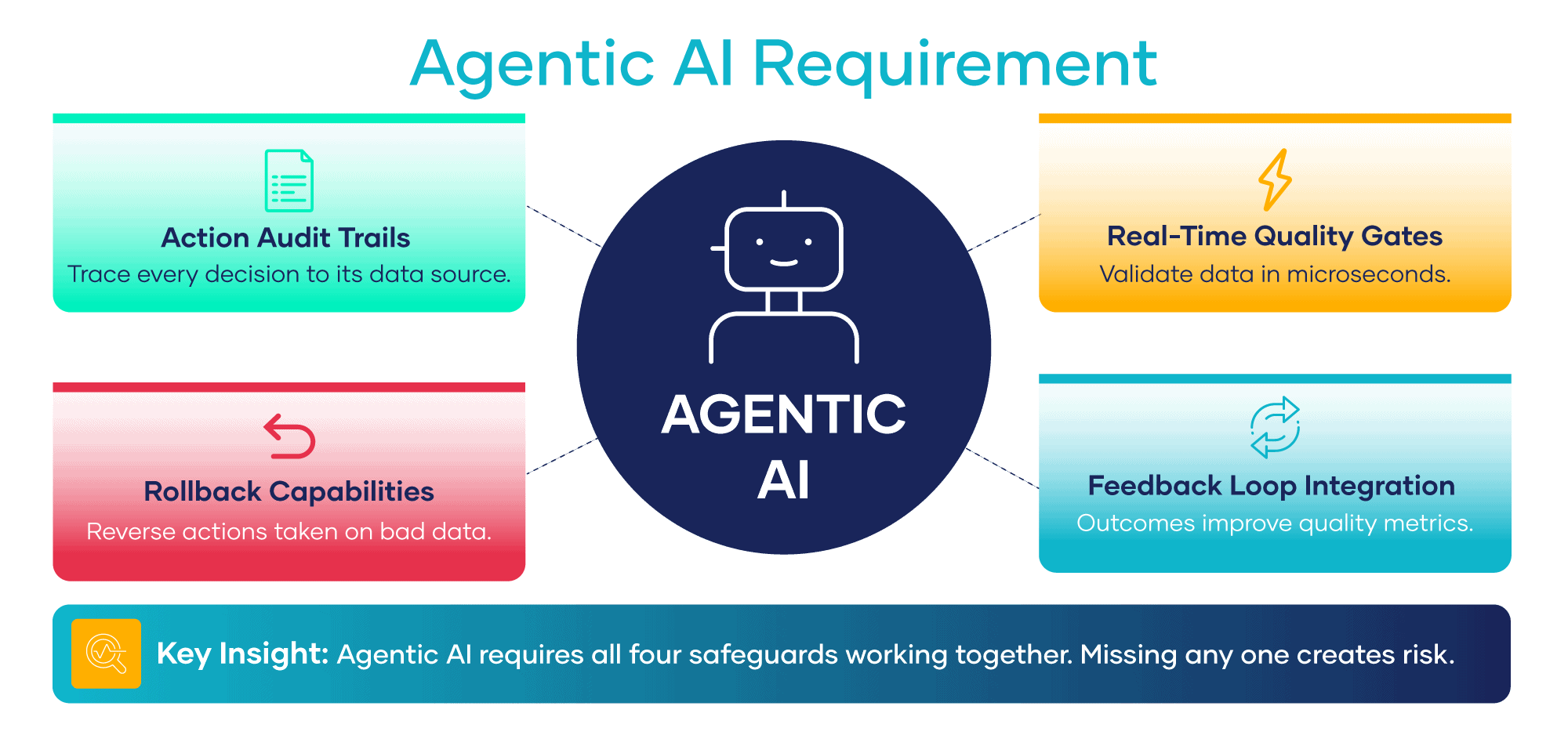
Agentic AI changes the math. These systems take autonomous actions rather than producing reports, and they need constant access to fresh data, so they generate more pipelines, more queries, and more telemetry, in real time. Every external tool monitoring those flows multiplies the credentials, egress paths, and service-provider relationships within regulatory scope.
The stakes rise at the same time. When an agent acts on data rather than merely describing it, an undetected quality failure or an exposed data path has immediate, sometimes irreversible, consequences for customers and the firm. Recognized guidance for managing these risks, such as the NIST AI Risk Management Framework, calls for governing data inputs, traceability, and the third parties in the loop as an integrated system (National Institute of Standards and Technology, 2023). Governing agentic AI therefore demands observability that does not itself widen the third-party surface it is meant to protect.
Architectural Insight: The Two Camps vs the Unified Solution
Legacy Paradigm: Decoupled, pull-based SaaS. A data-quality tool and a separate cost tool each connect from outside, extract telemetry to their own clouds, and leave you with two vendors, two security reviews, two egress paths, and two service-provider relationships to govern, while neither sees the whole picture.
DataRadar Paradigm: One unified Snowflake Native App that runs inside your account. Data quality monitoring and cost optimization share a single engine across the five dimensions, with zero data egress and zero metadata extraction, so there is no external recipient of customer information to supervise.
Closing the Loophole: Move the Watcher to the Data
The architectural answer is to stop pulling data out to watch it. DataRadar runs entirely inside your Snowflake account as a Native App. It inherits the controls you already use, your Snowflake role-based access control, your encryption, your network policies, and your compliance posture, rather than standing up a parallel set in someone else’s cloud (Snowflake Inc., 2024). There is zero data egress and zero metadata extraction. Your security team reviews one architecture rather than evaluating a new external vendor, and the app deploys from the Snowflake Marketplace in under 30 minutes, paid for with existing Snowflake credits.
Trace that back through the two regimes. Because the customer information never leaves your perimeter and no external party receives telemetry, the FINRA 21-29 vendor-supervision burden and the Reg S-P service-provider-oversight and breach-notification surface for the monitoring function largely disappear. There is simply no third party to oversee it. The loophole closes because the data flow that created it no longer happens.
The unification matters just as much. The market is split into a data-quality camp and a cost-optimization camp, which forces most firms to buy one tool for quality and another for cost, thereby doubling the vendor exposure described above (DataRadar, 2026). DataRadar covers all five dimensions- Data Reliability, Pipeline Health, Performance Optimization, Usage Intelligence, and Cost Visibility- in a single app approved app. You close the loophole and the visibility gap at once, which is the practical meaning of the four pillars: Unified, Native, Rapid, and Approved.
Upcoming Live Virtual Presentation: Reserve Your Seat
Data teams are not flying blind because they lack tools. They are flying blind because their tools only cover part of the picture. Join us for a live, deep-dive session mapping the five dimensions of complete data visibility and what it actually takes to close every operational gap.
Title: The Five Dimensions of Data Observability
Date: Thursday, August 13, 2026
Time: 11:00 a.m. PT / 2:00 p.m. ET
Duration: 30 minutes plus a live 15-minute Q&A
Format: Live virtual presentation plus Q&A
Host: Ken Kasee, Brand Director, DataRadar
Featured Speaker: Ram Sola, Product Architect, DataRadar
Conclusion: Close the Loophole by Design
In financial services, the safest data flow is the one that never happens. Treating observability as something that must extract your data turns a monitoring decision into an outsourcing decision under FINRA 21-29 and a privacy decision under SEC Reg S-P, complete with due diligence, ongoing supervision, breach-notification scope, and an examiner who will ask to see all of it. A zero-egress Snowflake Native App removes the flow, collapses the vendor surface, and unifies quality and cost in one approved app. The loophole is not something you monitor your way out of. It is something you design out. Visit dataradar.io to see the model in your own account.
Frequently Asked Questions
Does using an external data observability tool count as outsourcing under FINRA 21-29?
If the tool performs a function that you would otherwise supervise in-house and it has access to your customer data, FINRA expects you to treat it as a supervised vendor: due diligence, contract and default-setting controls, and ongoing oversight for the life of the agreement. The cleanest way to reduce that burden is to remove the external data flow entirely download, The 2026 Enterprise Playbook for Data Observability.
Is query metadata really customer information under Reg S-P?
It can be. Query logs can embed identifiers in filter values, and samples can hold nonpublic personal information directly. Once that telemetry reaches a vendor, that vendor receives customer information and falls within your Reg S-P service-provider oversight and breach-notification scope. Keeping the analysis in-warehouse keeps the information from leaving in the first place. download the 2026 Insight Brief: Data Quality and Cost Optimization. [UTL]
How does a Snowflake Native App reduce our service-provider oversight burden?
A Native App runs inside your Snowflake account under your existing RBAC, encryption, and network policies, with no data egress and no metadata extraction. Because no external party receives your customer information, there is no new service provider to onboard, supervise, or fold into breach-notification analysis for that monitoring function, download The 2026 Enterprise Playbook for Data Observability.
What changes for compliance when we deploy agentic AI on Snowflake?
Agentic systems generate more data flows and act on data autonomously, so both your exposure surface and your stakes increase. Observability that extracts data multiplies the credentials and vendor relationships in scope at the worst possible time. In-warehouse, zero-egress monitoring lets you govern data quality and traceability for agents without adding third-party surface, download the 2026 Insight Brief: Data Quality and Cost Optimization. [UTL]
Do we still need a separate FinOps tool if we use DataRadar?
No. The market splits quality and cost across two camps, which is what forces firms to run two tools and govern two vendors. DataRadar unifies data quality monitoring and cost optimization across all five dimensions in one Snowflake Native App, so you close the visibility gap without adding a second external relationship, download The 2026 Enterprise Playbook for Data Observability.
References
1.DataRadar. (2026). The 2026 enterprise playbook for data observability. https://www.dataradar.io/resources/playbooks/data-observability-playbook-2026/
2.Financial Industry Regulatory Authority. (2021). Regulatory Notice 21-29: FINRA reminds firms of their supervisory obligations related to outsourcing to third-party vendors. https://www.finra.org/rules-guidance/notices/21-29
3.Gramm-Leach-Bliley Act, 15 U.S.C. §§ 6801-6809 (1999). https://www.govinfo.gov/content/pkg/USCODE-2011-title15/html/USCODE-2011-title15-chap94.htm
4.National Institute of Standards and Technology. (2023). Artificial intelligence risk management framework (AI RMF 1.0). https://doi.org/10.6028/NIST.AI.100-1
5.Snowflake Inc. (2024). Snowflake Native App Framework [Documentation]. https://docs.snowflake.com/en/developer-guide/native-apps/native-apps-about
6.U.S. Securities and Exchange Commission. (2024). Regulation S-P: Privacy of consumer financial information and safeguarding customer information (Final rule). https://www.federalregister.gov/documents/2024/06/03/2024-11116/regulation-s-p-privacy-of-consumer-financial-information-and-safeguarding-customer-information